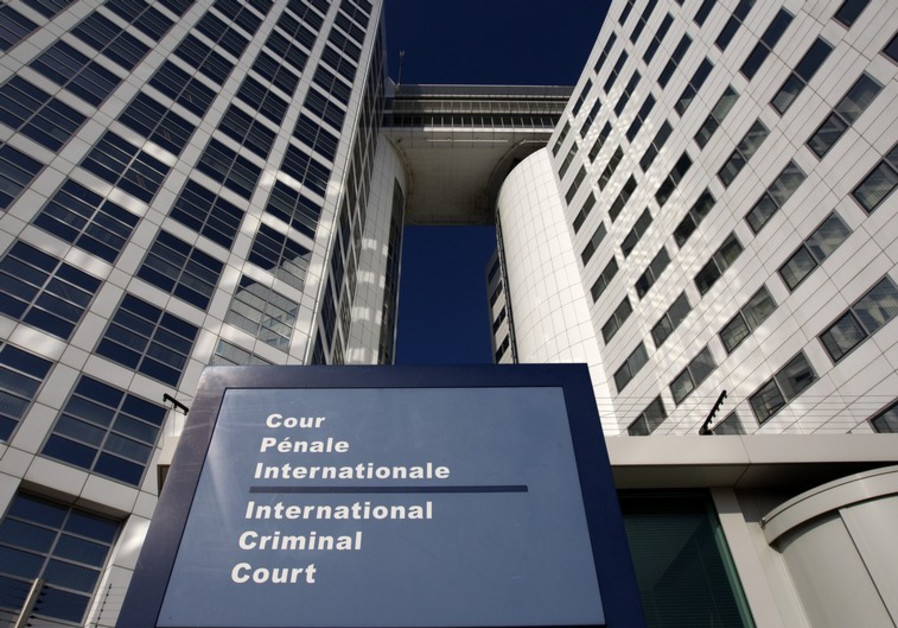
The entrance of the International Criminal Court (ICC) is seen in The Hague.
(photo credit: REUTERS)
X
Dear Reader,
As you can imagine, more people are reading The Jerusalem Post than ever before.
Nevertheless, traditional business models are no longer sustainable and high-quality publications,
like ours, are being forced to look for new ways to keep going. Unlike many other news organizations,
we have not put up a paywall. We want to keep our journalism open
and accessible and be able to keep providing you with news
and analyses from the frontlines of Israel, the Middle East and the Jewish World.
As one of our loyal readers, we ask you to be our partner.
For $5 a month you will receive access to the following:
Help us grow and continue telling Israel’s story to the world.
Thank you,
Ronit Hasin-Hochman, CEO, Jerusalem Post Group
Yaakov Katz, Editor-in-Chief
UPGRADE YOUR JPOST EXPERIENCE FOR 5$ PER MONTH
Show me later
Top Highs
3 - Justice Minister Ayelet Shaked’s High Court revolution
This year, Shaked completed a multiyear process in which she appointed
40% of the current justices on the High Court, including adding slightly
more conservatives than liberals. She and supporters on the Right have
called this a revolution that they hope will bring the court’s values
back in line with the voting public, which has repeatedly elected
right-wing governments in the last decade. They say that their own
revolution is necessary to reverse what is dubbed as the revolution of
former High Court chief Aharon Barak during the mid-1990s, in which the
court became more assertive about vetoing Knesset laws it viewed as
unconstitutional.
4 - International Criminal Court Prosecution versus Israelis
Time may no longer be on Israel’s side with International Criminal Court
prosecutor Fatou Bensouda being near a decision on Israel, Hamas and
war-crimes allegations, but the US is more firmly on Israel’s side than
it has been in years. Both US President Donald Trump and his national
security adviser, John Bolton, threatened the ICC with a variety of
consequences if it goes after either the US or Israel. Furthermore, in
the recent ICC report, there was a first sign that the it may give
Israel a broad pass on the 2014 Gaza war-crimes allegations. This would
be a stunning turnaround from a 2015 UN Human Rights Council report,
which condemned the IDF as having systematically perpetrated war crimes.
The ICC also suggested that since Hamas has not undertaken any probes
of its own actions, there would be no obstacle from her criminally
investigating its fighters for war crimes. Such a criminal investigation
against Hamas would be a first.
Top Lows
1 - The Netanyahus’ prosecutions
From the prime minister’s perspective, he is being hunted for having
wealthy friends and for trying to get fair coverage in the media, just
like other politicians who have varied dealings with media-outlet
owners. This would be a low since he argues that the Left has not been
able to beat him in elections, and is therefore trying to unseat him
through trumped up charges. His tune on this may shift once Mandelblit,
as expected, announces his intent to indict. The attorney-general cannot
be accused of being a left-winger or of bias against Netanyahu, having
served as his cabinet secretary immediately before the prime minister
got him his current job. In that case, Netanyahu is likely to argue that
Mandelblit was overcome by pressure from the allegedly left-wing legal
establishment that surrounds him.
2 - The High Court of Justice decision to hear petitions to strike
the Jewish Nation-State Law as unconstitutional
Those pushing for the law, especially Shaked, were furious that the High
Court did not reject the petitions against it with no hearing. They say
that since the law was passed as a Basic Law, it has
quasi-constitutional status and that it is beyond the court’s authority.
Shaked and others did not even beat around the push; they threatened a
variety of measures to reduce the court’s powers if it decides to strike
the law. For them, the law finally begins to strengthen and define
Jewish values in cases where they think that courts have used the
state’s democratic character to stomp on its Jewish character. There
have already been some lower-court decisions which cited the law as a
basis for new precedents.
4 - International Criminal Court Prosecution versus Israel
Four
years after launching a preliminary review, International Criminal
Court prosecutor Fatou Bensouda reported this month that she is close to
a decision on whether to open a full-fledged criminal probe against
Israel and Hamas for alleged war crimes. This could be very bad news for
Israel, legally and diplomatically. Until now, the best thing about the
ICC, as opposed to other UN-type bodies, was that it had not rushed to
judgment against Israel about war-crimes allegations dating back to the
2014 Gaza War. The war-crimes issue was continuously pushed off despite
Palestinian Authority demands for a decision years ago. A decision in
the near future would nix a scenario that Israel would have preferred,
where Bensouda might wait to decide until November 2020 and the possible
election of new US president less hostile to the ICC. Also, Bensouda
has issued multiple real-time public warnings to Israel about potential
war crimes relating to the settlements, house demolitions and the
ongoing conflict on the Gaza border. Finally, the ICC Pretrial Chamber
bizarrely tried to resurrect a war-crimes case against Israel relating
to the 2010 Mavi Marmara flotilla, despite Bensouda herself deciding not
to prosecute it multiple times.
5 - High Court orders state to let Lara Alqasem into the country and
freezes similar proceedings
For critics of the decision, this was a major self-inflicted wound.
After being hit for years by the BDS-movement, the Knesset and minister
Erdan finally conceived of ways to fight back. One way was to deny BDS
activists entry into Israel so that they could not use the country’s
free openness for their propaganda. Moreover, some BDS activists or
those considering BDS activism have strong ties to aspects of Israel;
despite their critical views, they do not want to be barred from
visiting. Critics said that alqasem had tried to cover up her past and
that she would return to her BDS roots as soon as she left Israel – and
with renewed propaganda from her time here. They said that BDS must be
fought with strength and not naivete, which the two lower courts had
agreed with. For them, losing the case weakened the entire policy of
limiting BDS activists' access and left Israel more vulnerable.
Join Jerusalem Post Premium Plus now for just $5 and upgrade
your experience with an ads-free website and exclusive content. Click
here>>
Share on facebook

No comments:
Post a Comment